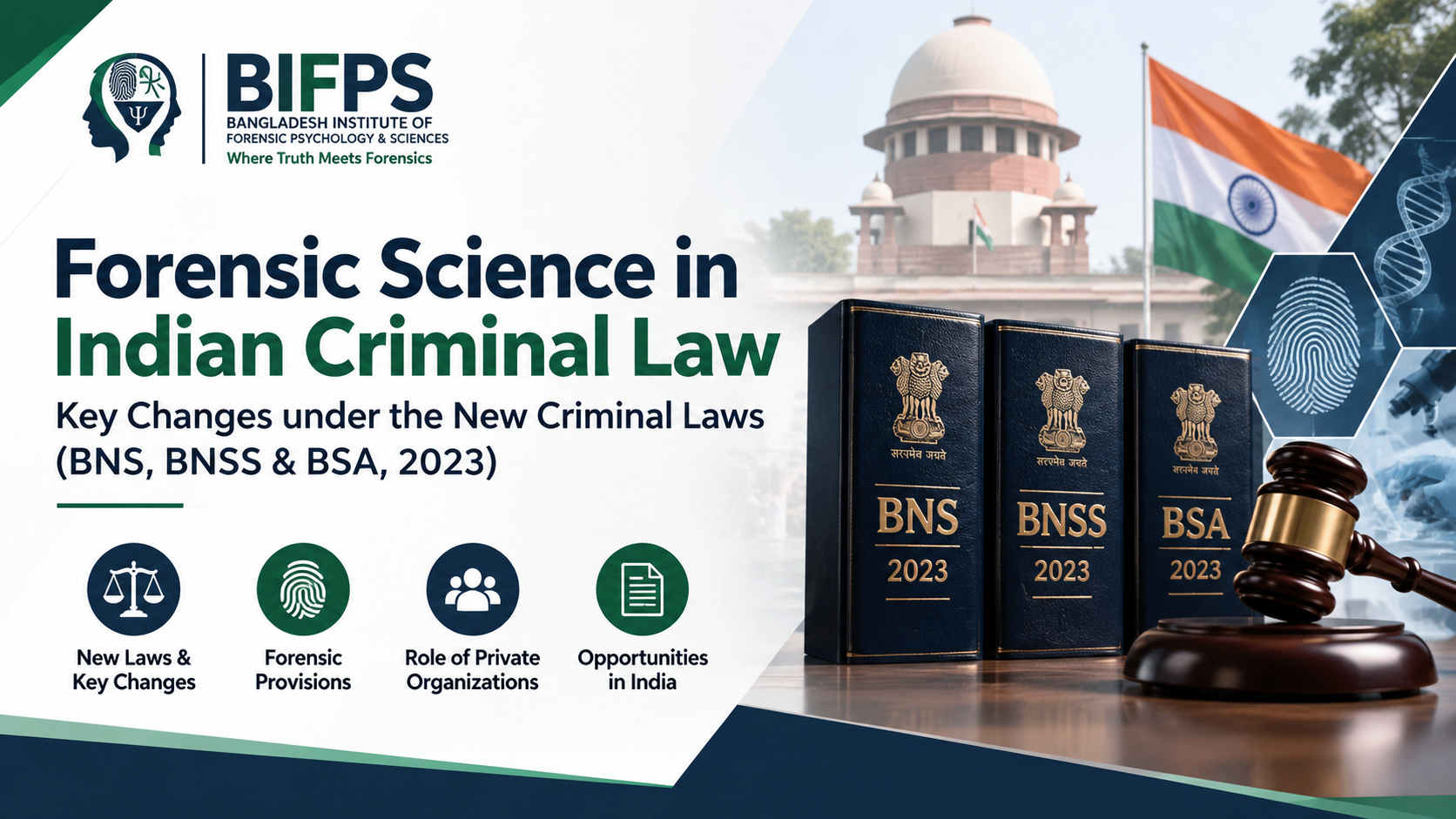
Forensic Science in Indian Criminal Law
History, Evolution and the Forensic Reforms Introduced by India's New Criminal Laws (BNS, BNSS & BSA, 2023)
A reference note compiled from official Government of
India sources
1. Introduction
Forensic science, the application of scientific methods to
the investigation of crime, has moved from being a peripheral, discretionary
tool of Indian policing to a statutorily mandated pillar of criminal
investigation. This shift culminated in 2023, when Parliament replaced India's
three foundational criminal statutes: the Indian Penal Code, 1860 (IPC), the
Code of Criminal Procedure, 1973 (CrPC), and the Indian Evidence Act, 1872
(IEA) with the Bharatiya Nyaya Sanhita, 2023 (BNS), the Bharatiya Nagarik Suraksha
Sanhita, 2023 (BNSS), and the Bharatiya Sakshya Adhiniyam, 2023 (BSA),
respectively. This document traces the history of forensic science
administration in India, the legislative reform process leading up to 2023, and
details the specific forensic-related changes introduced in the new laws,
drawing on official Government of India sources.
2. Colonial and Early Institutional History
2.1 Colonial Era Foundations
Formal identification science in India began under British
administration with anthropometric and fingerprint bureaus in the late 19th
century, culminating in the Identification of Prisoners Act, 1920, a statute
that authorised police officers and magistrates to take measurements, finger
impressions and photographs of convicts and arrested persons, with mandatory
destruction of records upon acquittal or discharge.
Evidence law itself was codified early through the Indian
Evidence Act, 1872, drafted by Sir James Fitzjames Stephen, which governed the
admissibility, relevancy and proof of facts, including expert opinion in Indian
courts for over 150 years.
2.2 Post-Independence Build-Out of Forensic
Infrastructure
India's central forensic science infrastructure developed
gradually after Independence:
- The
Central Forensic Science Laboratory network traces its earliest roots to
the CID Scientific Section set up in Lahore in 1933, relocated after
Partition and reconstituted as the Forensic Science Laboratory, Punjab
(1961), later becoming CFSL Chandigarh (1978).
- The
Bureau of Police Research & Development (BPR&D) was created in
1970 to modernise Indian policing and promote the use of science and
technology in investigation, and administered the Central Forensic Science
Laboratories (CFSLs) for over three decades.
- The
Directorate of Forensic Science Services (DFSS) was carved out of BPR&D
in 2002 by the Ministry of Home Affairs, on the recommendations of the
National Human Rights Commission and the Padmanabhaiah Committee on Police
Reforms, to render “high quality and credible forensic services” to the
justice delivery system. DFSS now oversees Central Forensic Science
Laboratories at Chandigarh, Kolkata, Hyderabad, Pune, Guwahati, Bhopal and
New Delhi (the Delhi laboratory remains under the CBI).
- DNA
profiling was introduced into Indian forensic casework around 1989, and
has since become a central biological evidence technique in serious
offences.
- The
Gujarat Forensic Sciences University, established in 2008, was upgraded
and recognised by an Act of Parliament as the National Forensic Sciences
University (NFSU) in 2020, an Institution of National Importance under the
Ministry of Home Affairs, dedicated to forensic science, investigation and
criminology education, with campuses across India and abroad.
3. The Reform Process Leading to New Legislation
Calls to modernise India's colonial-era criminal statutes,
and to place forensic evidence on a firmer statutory footing, grew over several
decades:
- The
Law Commission of India's 87th Report (1980) reviewed the Identification
of Prisoners Act, 1920 and recommended modernisation, including procedural
safeguards and expansion of permissible measurements.
- The
Committee on Reforms of the Criminal Justice System (Justice V. S.
Malimath Committee, 2003) recommended empowering magistrates to authorise
collection of DNA, hair, saliva and semen samples, and generally
strengthening the scientific basis of investigation.
- The
Information Technology Act, 2000 first brought electronic records into the
Evidence Act framework as secondary evidence (Section 65B), a provision
later heavily litigated over certification requirements.
- The
Criminal Procedure (Identification) Act, 2022 repealed the Identification
of Prisoners Act, 1920. It significantly widened the scope of
“measurements” to include biometrics (fingerprints, palm prints, iris and
retina scans), physical and biological samples, and behavioural
attributes; expanded the category of persons from whom such data may be
collected; lowered the rank of officer empowered to collect it; and
created the National Crime Records Bureau (NCRB) as the central agency to
store this data, retained for up to 75 years.
- The
DNA Technology (Use and Application) Regulation Bill has been considered
by Parliament (though not yet enacted as of the latest available record)
as a further step toward a dedicated statutory framework for DNA evidence.
This reform trajectory fed directly into the drafting of the
three new criminal codes, which were introduced in Lok Sabha in August 2023,
notified on 25 December 2023, and brought into force on 1 July 2024.
4. The Three New Criminal Laws (2023)
|
New Law |
Replaces |
Subject
Matter |
|
Bharatiya
Nyaya Sanhita, 2023 (BNS) |
Indian Penal
Code, 1860 |
Substantive
criminal offences and punishments |
|
Bharatiya
Nagarik Suraksha Sanhita, 2023 (BNSS) |
Code of
Criminal Procedure, 1973 |
Investigation,
arrest and trial procedure |
|
Bharatiya
Sakshya Adhiniyam, 2023 (BSA) |
Indian
Evidence Act, 1872 |
Rules of
evidence and proof |
All three laws were notified on 25 December 2023 and came
into force on 1 July 2024, marking, according to the Ministry of Home Affairs,
a shift away from colonial-era criminal law toward a modernised,
technology-enabled and forensics-driven system of justice.
5. Forensic-Related Changes in the New Criminal Laws
5.1 Mandatory Forensic Visit to Crime Scenes — BNSS,
Section 176(3)
The single most significant forensic reform is Section
176(3) of the BNSS. For any offence punishable with imprisonment of seven years
or more, the officer in charge of a police station must ensure that a forensic
expert visits the crime scene to collect evidence, and that the entire process
is videographed on a mobile phone or other electronic device.
Under the earlier CrPC there was no statutory requirement of
this kind; forensic attendance depended entirely on local police discretion and
resource availability. Where a state lacks the necessary forensic facility, it
is required to use the facility of another state until its own is developed.
States have been given up to five years from notification to operationalise
this provision.
5.2 Mandatory Videography of Search, Seizure and Crime
Scene Forensics
Section 105 of the BNSS makes videography of search and
seizure proceedings mandatory, addressing a gap in the old Section 100 CrPC
framework, which had no audio-visual recording requirement. Videography of
statements of victims of sexual offences has also been made compulsory,
strengthening the evidentiary chain and reducing disputes over tampering or
procedural irregularity.
5.3 Expanded Biometric and Sample Collection — BNSS,
Section 349
Corresponding to Section 311A of the old CrPC, Section 349
of the BNSS significantly widens the categories of forensic samples a
magistrate may order to be collected, now expressly including finger
impressions, specimen signatures, handwriting and voice samples, and permits
such orders even against a person who has not been arrested.
5.4 Expert Testimony and the Treatment of Forensic
Reports — BNSS, Sections 329–330
Section 329 of the BNSS (corresponding to Section 293 CrPC)
continues the exemption of specified government scientific experts from having
to appear personally in court, while empowering the government to expand the
list of exempted experts, potentially opening the door to accredited
private/digital forensic examiners.
Section 330 further provides that an expert need not be
summoned to prove their report unless its genuineness is specifically disputed
by a party, increasing efficiency but drawing criticism that unchallenged
forensic reports may escape adversarial scrutiny.
5.5 Electronic and Digital Records as Primary Evidence —
BSA, Sections 57 & 63
Under the erstwhile Indian Evidence Act, 1872, electronic
records were treated as secondary evidence and required certification under
Section 65B. The BSA reclassifies electronic and digital records, including
emails, server logs, WhatsApp messages, CCTV footage and cloud-stored data, as
primary evidence.
The Section 63 certificate regime now requires two
signatures: one from the person in charge of the device that produced the
record, and one from a forensic expert, replacing the earlier single-signatory
requirement under Section 65B(4) of the IEA.
The certificate must follow a statutorily prescribed
schedule format, and the expert must state the hash value of the record and the
algorithm used to derive it, supporting integrity verification and
chain-of-custody documentation.
5.6 Expert Opinion Evidence — BSA, Section 39
Section 39 of the BSA (corresponding to Section 45 of the
IEA) governs when the court may rely on the opinion of persons “specially
skilled” in a relevant field of science, art, foreign law, or in identifying
handwriting or finger impressions, and has been read to extend to digital
forensic and other emerging expert domains.
5.7 Continuity with the Criminal Procedure
(Identification) Act, 2022
Although enacted separately from the three 2023 codes, the
Criminal Procedure (Identification) Act, 2022 operates alongside them as part
of the same forensic modernisation programme. It replaced the 1920 Act, widened
the categories of biometric and biological data that may be collected from
convicts, arrestees and persons under preventive detention, and created a
central database maintained by the National Crime Records Bureau, with records
retained for 75 years.
6. Implementation Measures
According to the Press Information Bureau, the Government of
India has undertaken a nationwide capacity-building exercise to operationalise
the forensic provisions of the new laws:
- The
Bureau of Police Research & Development (BPR&D) developed 13
training modules for police, prison, prosecution, judicial and forensic
personnel, and adopted a “Training of Trainers” model delivered through
the Central Academy for Police Training, Bhopal, and Central Detective
Training Institutes at Kolkata, Hyderabad, Chandigarh, Jaipur, Ghaziabad
and Bengaluru.
- 274
training courses, webinars and seminars have imparted training to over
43,000 officers and Master Trainers, while States/UTs have separately
trained over 8.4 lakh officials, including police, prison, forensic,
judicial and prosecution personnel.
- The
iGOT Karmayogi Bharat portal has run dedicated online courses on BNS, BNSS
and BSA for officials since February 2024.
- Under
the National Forensic Infrastructure Enhancement Scheme (NFIES), new
Central Forensic Science Laboratories have been approved for Kerala,
Chhattisgarh (Raipur), Odisha (Khordha), Tamil Nadu (Chengalpattu), Bihar,
Uttar Pradesh, Rajasthan and Jammu & Kashmir (Samba), alongside
deployment of mobile forensic vans across the country to support
crime-scene visits mandated under Section 176(3) BNSS.
Private Forensic Organisations and Judicial Scrutiny of
Scientific Interrogation Techniques in India
Involvement of Private Forensic Organisations in Solving
Criminal Cases
India's forensic infrastructure is primarily state-run: six
Central Forensic Science Laboratories (CFSLs) function under the Directorate of
Forensic Science Services, Ministry of Home Affairs, alongside State FSLs in
each state.
Because government laboratories face heavy caseloads and
long turnaround times, independent private forensic laboratories have emerged
over the last two decades to supplement—not replace—government forensic
capacity, particularly in urgent, sensitive or high-profile matters, and in
civil/family matters that never reach the police at all.[1]
2.1 Truth Labs (Hyderabad) — India's First Independent
Forensic Laboratory
Truth Labs was founded in October 2007 at Hyderabad by Dr
K.P.C. Gandhi, a former Inspector General of Police and Director of the Andhra
Pradesh Forensic Science Laboratory, along with a group of retired directors of
Central and State FSLs, with the backing of former Chief Justices of India,
former Supreme Court and High Court judges, and senior police and
administrative officials.[2]
It subsequently expanded to Delhi (2009), Chennai (2010),
and later Bangalore, Mumbai and Kolkata, and offers questioned-document
examination, disputed fingerprint analysis, forensic DNA profiling, cyber and
multimedia forensics, crime-scene investigation, polygraph/lie-detection
studies, and corporate, insurance and financial-fraud investigation.[3]
Over roughly sixteen years of operation it has reportedly
furnished reports in over 25,000–27,000 cases, its services being used by High
Courts and subordinate courts in more than twenty states, investigating
agencies such as the CBI, NIA and CRPF, over forty banks and twenty insurance
companies, and several hundred government departments and PSUs, with its
experts giving testimony that is admissible under Section 45 of the Indian
Evidence Act and Section 293 Cr.P.C. because they are former heads of government
FSLs.[4]
Truth Labs' founder has been publicly credited with forensic
work in high-profile investigations such as the Nithari killings and other
sensational cases referred to the Andhra Pradesh FSL during his tenure as its
Director.[5]
2.2 Other Private Forensic Service Providers
Other private laboratories, such as SIFS India (New Delhi),
similarly offer crime-scene investigation, questioned-document and handwriting
analysis, and digital/cyber-crime investigation services to police, courts,
lawyers and private clients, positioning themselves as a supplement to
government FSL capacity.[6]
2.3 Nature and Limits of Private Forensic Involvement
- Private
labs are typically approached directly by individuals, corporates, banks,
insurers and law firms for matters that do not involve the police (e.g.,
paternity disputes, corporate fraud, matrimonial disputes), as well as by
investigating agencies and courts in select cases.
- Admissibility
of a private expert's opinion in Indian courts flows from Section 45 of
the Indian Evidence Act, 1872 (now Section 39, Bharatiya Sakshya
Adhiniyam, 2023), which does not distinguish between government and
private experts, provided the witness is shown to possess the requisite
“special skill.”
- Private
labs cannot substitute for a court- or police-ordered forensic examination
in a criminal trial unless the investigating officer or court specifically
refers the matter or the private report is proved through expert testimony
under Section 293 Cr.P.C./equivalent BNSS provision.
3. Landmark Judgments on Narco-Analysis, Polygraph and
Brain Mapping (BEAP)
3.1 Selvi & Ors. v. State of Karnataka & Anr.
(2010) 7 SCC 263
This is the principal Indian authority on the
constitutionality of narco-analysis, polygraph examination and the Brain
Electrical Activation Profile (BEAP or “brain mapping”) test.
Decided on 5 May 2010 by a three-judge bench of the Supreme
Court comprising Chief Justice K.G. Balakrishnan and Justices R.V. Raveendran
and J.M. Panchal, the case arose from a batch of criminal appeals (Criminal
Appeal No. 1267 of 2004 and connected appeals) concerning the involuntary
administration of these techniques during criminal investigation.[7]
The Court held that compulsorily subjecting a person—whether
accused, suspect or witness—to narco-analysis, polygraph or BEAP tests amounts
to “testimonial compulsion” and therefore violates the right against
self-incrimination under Article 20(3) of the Constitution, as well as the
right to personal liberty and privacy under Article 21, since these tests
involve substantial mental and physical intrusion and unreliable, involuntary
revelations.[8]
The Court accordingly ruled that no such test may be
administered without the free, informed consent of the subject, and even where
consent is given, the guidelines earlier issued by the National Human Rights
Commission (relating to legal representation, judicial oversight and medical
safeguards) must be followed.
Further, any statement made during a voluntarily
administered test does not by itself constitute a “confession”, and only
information/material subsequently and independently discovered as a result
(under Section 27 of the Evidence Act) can be treated as admissible.[9]
Selvi drew on the Court's earlier eleven-judge bench ruling
in State of Bombay v. Kathi Kalu Oghad (1961), which had held that purely
physical evidence such as fingerprints, handwriting specimens or blood samples
does not attract Article 20(3) because it is not “testimonial” in character,
while treating narco-analysis and BEAP differently because they seek to extract
communicative/testimonial content from the subject's mind.[10]
3.2 Ritesh Sinha v. State of Uttar Pradesh & Anr.,
(2019) 8 SCC 1
In this later three-judge bench decision (Chief Justice
Ranjan Gogoi with Justices Deepak Gupta and Sanjiv Khanna), decided on 2 August
2019, the Supreme Court held that compelling an accused to give a voice sample
for forensic comparison does not violate Article 20(3), since, like
fingerprints or handwriting, a voice sample is treated as physical,
non-testimonial evidence rather than a communication of personal knowledge.[11]
Finding that Sections 53, 53A and 311A of the Code of
Criminal Procedure, 1973 (which cover medical examination and specimen
signatures/handwriting) did not expressly empower a Magistrate to order a voice
sample, the Court used its power under Article 142 of the Constitution to fill
this legislative gap and held that a Magistrate can direct an accused to
furnish a voice sample even absent an explicit statutory provision, until
Parliament enacts one.[12]
This ruling is frequently read alongside Selvi because it
illustrates the dividing line the Court draws between:
(a) physical/identificatory evidence, permissible even under
compulsion; and
(b) techniques such as narco-analysis and BEAP that probe
the subject's mental processes and communicative faculties, which cannot be
compelled.
3.3 Practical Use of Narco-Analysis in High-Profile
Indian Investigations (Pre-Selvi)
Before the 2010 Selvi ruling restricted involuntary use of
the technique, narco-analysis was reported to have been used by investigating
agencies in a number of high-profile Indian cases, including the Aarushi Talwar
murder case, the Nithari killings, the Telgi stamp-paper scam, and
investigations connected with the Mumbai bomb blasts, illustrating both the
investigative appeal of the technique and the controversy that led to
Selvi.[13]
4. Conclusion
Private forensic organisations such as Truth Labs and
similar laboratories have carved out a genuine, if supplementary, role in the
Indian criminal justice ecosystem, easing the burden on overstretched
government FSLs, offering faster turnaround for urgent cases, and extending
forensic access to civil and personal disputes that never reach the police.
Their reports gain evidentiary value under Section 45 of the
Evidence Act once proved through competent expert testimony, but they do not
enjoy any special constitutional status.
Separately, and more fundamentally, the Supreme Court's
decisions in Selvi v. State of Karnataka (2010) and Ritesh Sinha v. State of
Uttar Pradesh (2019) together define the constitutional boundary within which
any forensic technique, private or governmental, must operate: purely physical
evidence may be compelled, but any technique, such as narco-analysis, polygraph
examination or brain mapping (BEAP), that seeks to extract testimonial content
from an unwilling subject's mind cannot be administered without free and
informed consent.
Sources Consulted
Primary Sources (Courts)
- Selvi
& Ors. v. State of Karnataka & Anr., Criminal Appeal No. 1267 of
2004, Supreme Court of India, judgment dated 5 May 2010. Official copy: https://main.sci.gov.in/jonew/judis/36303.pdf
- Selvi
& Ors. v. State of Karnataka & Anr., 2010 (7) SCC 263. Indian
Kanoon: https://indiankanoon.org/doc/338008/
- Ritesh
Sinha v. State of Uttar Pradesh & Anr., Criminal Appeal No. 2003 of
2012, Supreme Court of India, judgment dated 2 August 2019, (2019) 8 SCC
1. Indian Kanoon: https://indiankanoon.org/doc/18061439/
- State
of Bombay v. Kathi Kalu Oghad, AIR 1961 SC 1808 (referred to in Selvi,
discussed via secondary commentary above).
Secondary / Open-Source Materials
- Truth
Labs, “About Us”: https://www.truthlabs.org/about-us/
- Truth
Labs, “FAQ”: https://www.truthlabs.org/faqs/
- “Meet
The Andhra Pioneer Behind India's 1st Independent Forensic Investigation
Lab,” The Better India (1 November 2018): https://thebetterindia.com/163531/kpc-gandhi-truth-labs-forensic-andhra/
- SIFS
India, “Forensic Laboratory in India | Expert Services”: https://www.sifsindia.com/blog-details/forensic-laboratory-in-india-expert-services
- “Evidentiary
value of Narco-Analysis and Brain Mapping in India vis-à-vis Smt. Selvi
& Ors. v. State of Karnataka (2010),” Legal Desire: https://legaldesire.com/evidentiary-value-of-narco-analysis-and-brain-mapping-in-india-vis-a-vis-smt-selvi-ors-v-state-of-karnataka-2010/
References
[1] Directorate of Forensic Science Services — About: http://dfs.nic.in/aboutDirectorate.html
[2] Ministry of Home Affairs — Directorate of Forensic
Science (DFS): https://www.mha.gov.in/en/directorate
of forensic science dfs
[3] National Forensic Sciences University: https://www.nfsu.mha.gov.in/
[4] Press Information Bureau — Implementation of BNS, BNSS
and BSA: https://www.pib.gov.in/PressReleseDetailm.aspx?PRID=2036414
[5] India Code — The Bharatiya Sakshya Adhiniyam, 2023: https://www.indiacode.nic.in/handle/123456789/20063
[6] Ministry of Home Affairs — Text of the Bharatiya Sakshya
Adhiniyam, 2023 (Gazette): https://www.mha.gov.in/sites/default/files/2024
04/250882_english_01042024_0.pdf
[7] PRS Legislative Research — The Bharatiya Sakshya Bill,
2023: https://prsindia.org/billtrack/the
bharatiya sakshya bill 2023
[8] PRS Legislative Research — The Bharatiya Nagarik
Suraksha Sanhita, 2023: https://prsindia.org/billtrack/the
bharatiya nagarik suraksha sanhita 2023
[9] PRS Legislative Research — The Criminal Procedure
(Identification) Bill, 2022: https://prsindia.org/billtrack/the
criminal procedure identification bill 2022
[10] PRS Legislative Research — Criminal Procedure
(Identification) Rules, 2022: https://prsindia.org/billtrack/criminal
procedure identification rules 2022
[11] Ministry of Home Affairs — Criminal Procedure
(Identification) Act, 2022 (Gazette notification): https://www.mha.gov.in/sites/default/files/2022
11/CriminalPro_14112022[1].pdf
[12] Government of India (S3WAAS) — Paper on Electronic
Evidence under BSA/BNSS: https://cdnbbsr.s3waas.gov.in/s3ec01a0ba2648acd23dc7a5829968ce53/uploads/2024/12/2024122766.pdf
Additional Footnotes
- Truth
Labs, “Frequently Asked Questions,” truthlabs.org, https://www.truthlabs.org/faqs/
(accessed 13 July 2026).
- Truth
Labs, “About Us,” truthlabs.org, https://www.truthlabs.org/about-us/
(accessed 13 July 2026).
- Truth
Labs, “About Us,” truthlabs.org, https://www.truthlabs.org/about-us/
(accessed 13 July 2026).
- Truth
Labs, “About Us” and “FAQ,” truthlabs.org, https://www.truthlabs.org/about-us/
and https://www.truthlabs.org/faqs/
(accessed 13 July 2026).
- “Meet
The Andhra Pioneer Behind India's 1st Independent Forensic Investigation
Lab,” The Better India, 1 November 2018, https://thebetterindia.com/163531/kpc-gandhi-truth-labs-forensic-andhra/.
- SIFS
India, “Forensic Laboratory in India | Expert Services,” sifsindia.com, https://www.sifsindia.com/blog-details/forensic-laboratory-in-india-expert-services
(accessed 13 July 2026).
- Selvi
& Ors. v. State of Karnataka & Anr., Supreme Court of India,
Criminal Appeal No. 1267 of 2004, judgment dated 5 May 2010; official text
at https://main.sci.gov.in/jonew/judis/36303.pdf;
also reported at Indian Kanoon, https://indiankanoon.org/doc/338008/.
- Selvi
& Ors. v. State of Karnataka & Anr., 2010 (7) SCC 263; text at https://main.sci.gov.in/jonew/judis/36303.pdf.
- Selvi
& Ors. v. State of Karnataka & Anr., 2010 (7) SCC 263, paragraphs
on NHRC guidelines and Section 27 Evidence Act; https://indiankanoon.org/doc/338008/.
- State
of Bombay v. Kathi Kalu Oghad, AIR 1961 SC 1808, discussed in Selvi &
Ors. v. State of Karnataka, 2010 (7) SCC 263.
- Ritesh
Sinha v. State of Uttar Pradesh & Anr., Criminal Appeal No. 2003 of
2012, judgment dated 2 August 2019, (2019) 8 SCC 1; text at Indian Kanoon,
https://indiankanoon.org/doc/18061439/.
- Ritesh
Sinha v. State of Uttar Pradesh & Anr., (2019) 8 SCC 1; https://indiankanoon.org/doc/18061439/.
- “Evidentiary
value of Narco-Analysis and Brain Mapping in India vis-à-vis Smt. Selvi
& Ors. v. State of Karnataka (2010),” Legal Desire, https://legaldesire.com/evidentiary-value-of-narco-analysis-and-brain-mapping-in-india-vis-a-vis-smt-selvi-ors-v-state-of-karnataka-2010/
(accessed 13 July 2026).